French Guiana
Kourou: Launch of an Ariane 5
From Fernando de Noronha/Brazil to Degrad des Cannes in French Guiana
Together with the German yacht Momo, we left this romantic nature reserve island much earlier than planned, forced to do so due to some petty bureaucratic unpleasantness (please see our report from August 03). After a six-month stay in Brazil, this new law hit us quite hard and unprepared. But so what, whining doesn't help anymore. After a few days on the high seas, my annoyance was gone and I enjoyed the wonderful sailing weather. The positive impression that Brazilians and their country made on us far outweighs the few negative aspects. If our stay hadn't been limited to half a year, I wouldn't be reporting on this crossing today, but rather continuing to share our experiences in Brazil.
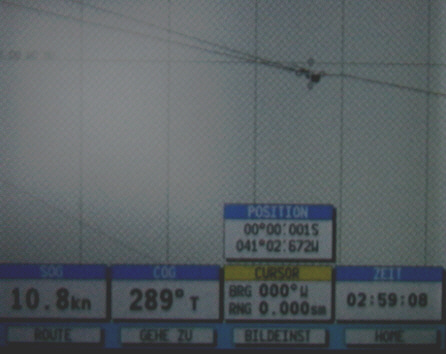
With tailwinds and current with us, the water really just rushes under our keel. At 10.8 knots speed over ground, and that is truly no fisherman's yarn, we crossed the equator for the second time now. This time, however, from south to north, but unfortunately again in pitch-black night. Thus, I still haven't properly seen the equator. Hopefully, it will finally work out next time.
Wonderful sailing weather, an excellent mood on board, and the galley provided delicious warm meals every day. The dreaded sleep deficit, sometimes a minor and occasionally even a major problem for a crew of two, kept within limits this time. The only ones who certainly couldn't be satisfied with this great crossing were our companions outside the board. They got absolutely nothing for free from us along the entire route, except for the kitchen scraps. In return, however, they took their revenge. Not a single fish bit during the entire crossing. I really didn't think this was possible and tried to outsmart them with every bait available to me. Finally, I even tied an old frayed rubber glove to the hook, a technique I read about from an experienced circumnavigator. Success again equal to zero. The fish outsmarted me this time. Luckily, Wolfgang from the German Momo had the right bait out. Twice he sent a radio message reporting that smaller tuna had bitten. Shortly before Guiana, he even had a really big fellow on the hook. A roughly one-meter-long dolphinfish sacrificed itself to feed the two MOMO crews for a week.
French Guiana
This small French overseas department, discovered by Columbus in 1498, is roughly twice the size of Switzerland in terms of area. However, it has only a little more than 2% of Switzerland's population. Over 90% of the land area here is still genuine primeval forest. Incomprehensibly, less than 1% of the area is used for agriculture. The largest part of the food must therefore be imported from abroad, primarily from France, of course. But that only explains the horrendous prices in this country to a small extent.
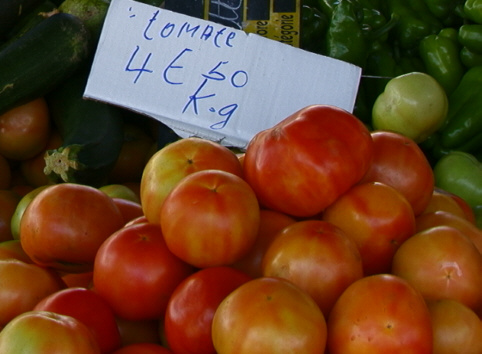
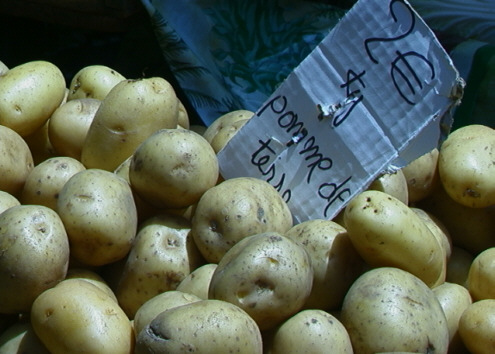
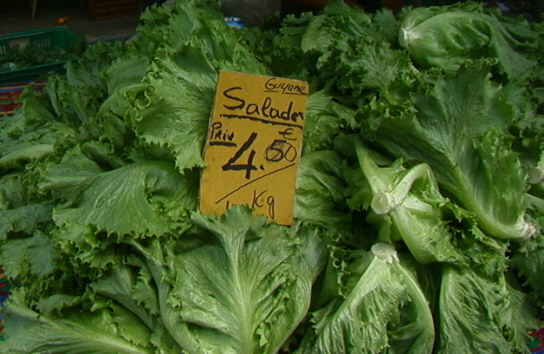
Even though we knew about it beforehand, this came as a real shock to us. Following the heavenly prices in Brazil, we are now being asked for exorbitant sums here. They want 7,-- CHF for a kilogram of tomatoes, 3.10 CHF for a kilogram of potatoes, and 7,-- CHF for a kilogram of ordinary green lettuce. Yesterday we wanted to buy zucchini, but with a price of 20.15 CHF per kilogram, we had to pass.
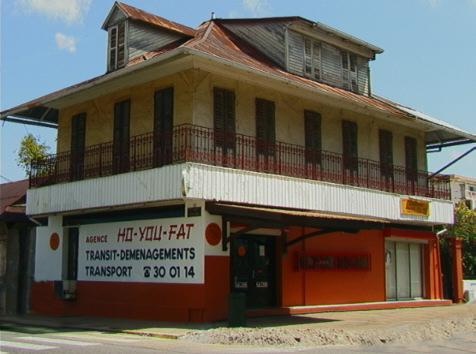
The mix of ethnic groups is also striking here. From very dark to very fair, from indigenous descent to immigrated Asians, everything is represented. The people from the Far East have also practically divided all of business life among themselves. Today there are truly only a frighteningly small number of restaurants and shops that are not controlled by Asians. I believe the French government even welcomes this situation, because this way the native Guyanese do not get their hands on economic power and therefore do not even think about an independent state.
The spontaneous warmth of the Brazilians does not exist here. Instead, we sense a somewhat rejecting or even slightly distrustful underlying mood. In any case, the change must always be counted carefully, or a euro will certainly be missing. In the small harbor of Degrad des Cannes, all the fishermen are from Brazil. The French own the fishing boats and the Brazilians do the hard work. When we exchange a few words in Brazilian Portuguese with them, they really light up. When they also find out that we liked Brazil very much, we get the fish at a friendly price, or even completely for free. Well, we do not want it for free, so a few cans of Brazilian beer from our fridge go over to a fishing boat.
Kourou, the European spaceport, Centre Spatial Guyanais
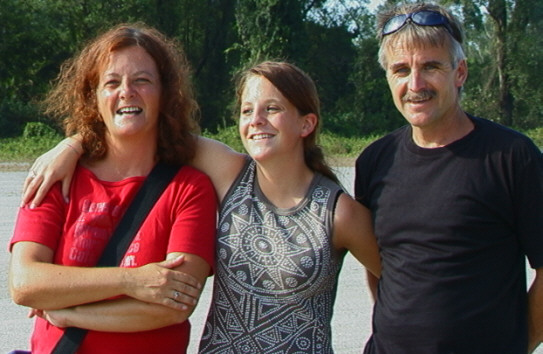
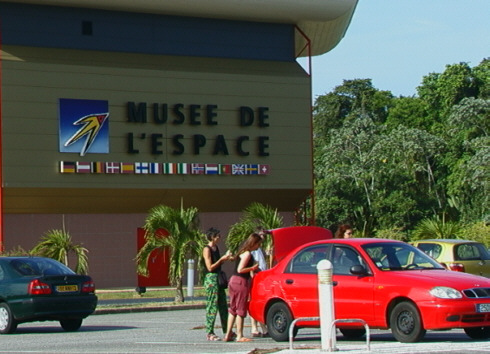
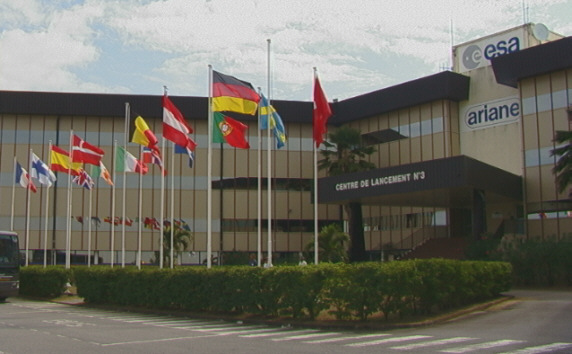
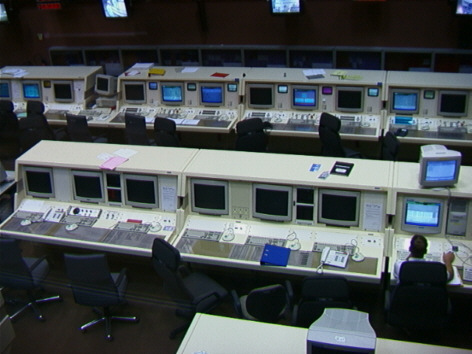
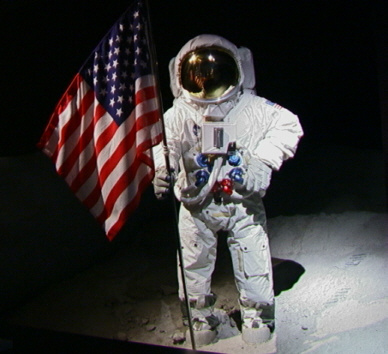
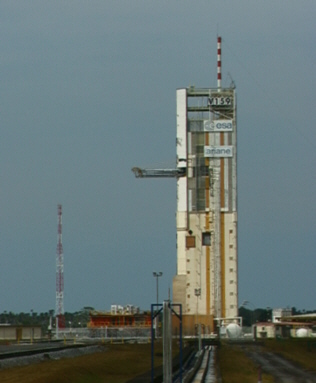
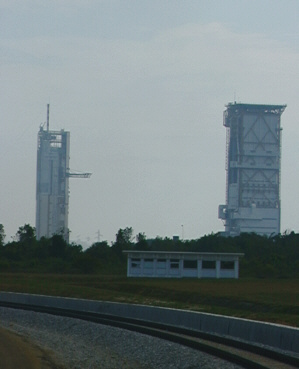
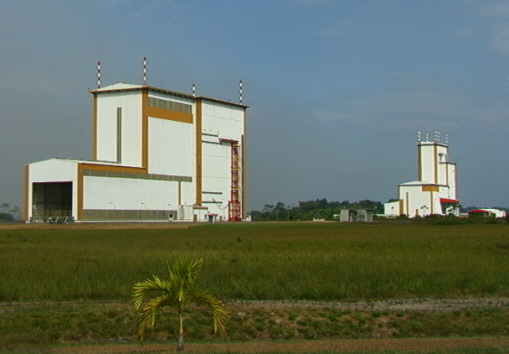
Here the contrasts are certainly greatest. In terms of landscape, the ultramodern assembly halls and the launch pads for satellites border directly on the primeval forest. In terms of population, there are people in the adjacent jungle who still live today without any modern technology and electricity. With our friends from Switzerland, Gabi Jüre and Claudia, we visited the Centre Spatial Guyanais and the attached Musée de L'Espace. The truly interesting guided tour through the entire grounds of this European spaceport had to take place by bus, as the distances between the individual assembly halls, the launch pads, and the control center are so huge here. The grandstand from which paying guests can experience a launch live is 6 km away from the launch pad. The size of the entire area is approximately 21 km2. Coincidentally, we were the last group allowed to visit the launch pad before the next Ariane 5 launch. What looks quite small in the photos is actually tremendous and mighty. The presentation in the Jupiter control center was also impressive. I already knew this facility from television. Sitting inside there now and imagining the material responsibility and frantic activity that some people will experience next Saturday, right before the launch, is quite something.
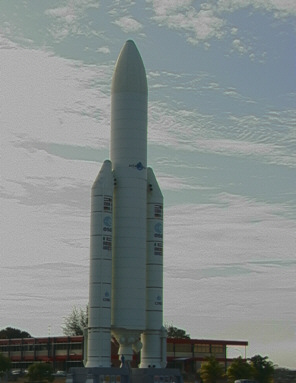
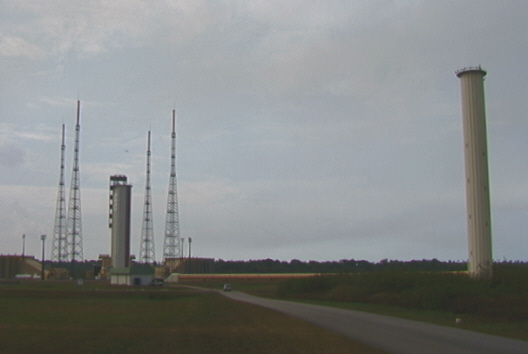
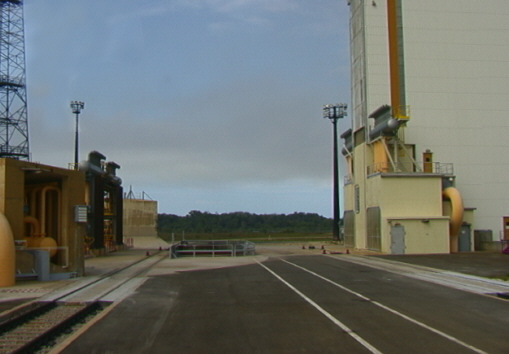
September 27, 2003, 20:02 - Launch of Ariane 5, Flight 162
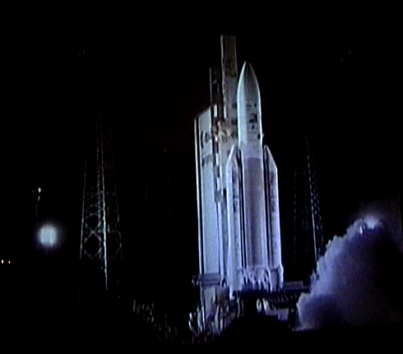
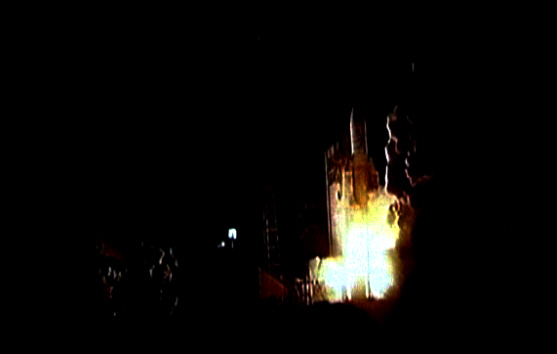
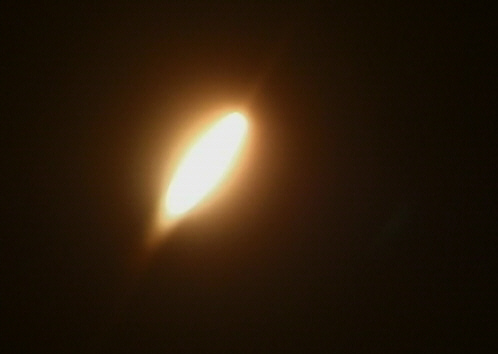
Without knowing or planning it beforehand, we dropped anchor here in French Guiana at precisely the right time. On 27 September, at 20:02, another launch of an Ariane 5 is scheduled. Naturally, this is a spectacle we do not want to miss. Already an hour beforehand, we are on Site Carapa, the hill closest to the launch pad. Along with us, there are already over a thousand people on site. There is strict admission control and only a total of 1500 people are allowed up onto this hill. A large screen broadcasts the final work, checks, and the tense atmosphere in the control centres. In between, video clips of the installation of the satellites to be transported are shown. Here on the hill, too, the tension rises, almost like at a cup final. The countdown proceeds as planned, until seven minutes before launch. Suddenly, one of the many control lights changes from green to red. Brief excitement, until the reason is announced. The two booster tanks needed more time to pass all checks. After a few minutes, the problem is fixed as well and the clock ticks further toward zéro. Fortunately, everything stays within the prescribed time window of 20 minutes, in which a launch must inevitably take place. If this time span is not sufficient, the whole exercise would have to be aborted and postponed by at least 24 hours.
4-3-2-1-0 and then we saw an almost indescribable fireworks display. Even from our distance of 12 km, we felt the vibration and dull roar in the air. As the heavy rocket moved skywards, first in slow motion and then with uncanny acceleration, we could only marvel at how far humanity has advanced in this technology. Resembling a fireball, with a long trail in its wake, it overcame the laws of gravity. After a few minutes, the two booster tanks were empty, were jettisoned from the rocket, and fell back into the sea. A short time later, Ariane 5 had reached its planned trajectory. The first satellite was deployed. This was also achieved without any problems for the next two. The spectacle was thus over and the viewing hill slowly emptied again.
Impressive as the whole thing was, it does raise a few small questions. What actually happens to the many animals living there in the immediate vicinity? During our visit and guided tour of the Centre Spatial Guyanais, the responsible people spoke only of biodiversity and how they generously left plenty of space for the wild animals. How many of these perish, in other words get roasted, during a rocket launch was never mentioned.
Jungle Trip
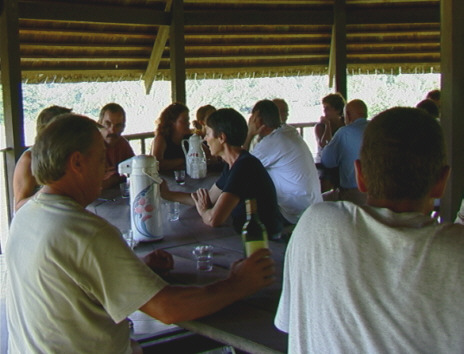
Promptly at 7:00 in the morning, we were picked up by Gérard at our boats in the harbour of Degrad des Cannes. We were Gabi with Jürg and Claudia, our friends from Switzerland, Barbara with Wolfgang from the German Momo, and of course Yvonne and yours truly. First, we drove about 120 km, always dodging the potholes well, until the village of Regina.
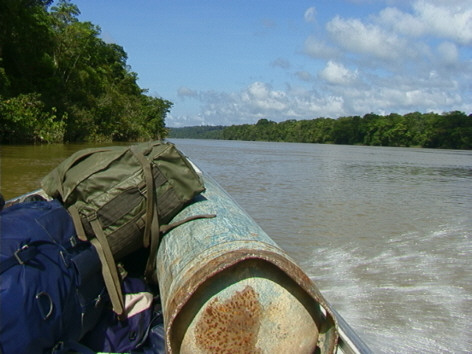
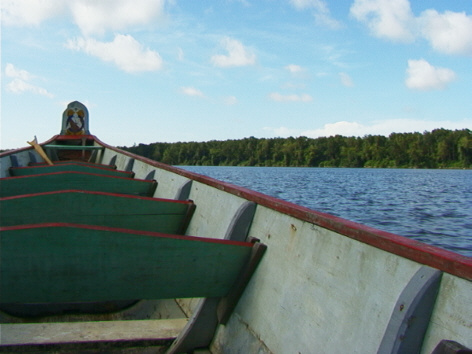
His fast pirogue was already waiting for us there. From here on, this is the only means of transportation still possible. Once made entirely of wood, but today mostly constructed of aluminium and equipped with a powerful outboard motor, these race across the water. For the few people living here in the jungle, this is the only way to contact the outside world. After a 1.5-hour ride and skilfully crossing shallows, we reached the first rapids. For us, it was clear that now it was time to get out. Far from it. Gérard gave more gas, we held on even tighter to the pirogue, and it easily climbed these tricky passages. We only learned later that this is not always so easy. Everything for the illegal gold miner camp with its roughly 6000 adventurers, located further upstream, has to be brought up here as well. It sometimes happens that a boat goes sideways, tips over, and drifts its entire cargo back downstream. Gérard, at any rate, mentioned that he had often replenished his food supplies this way.
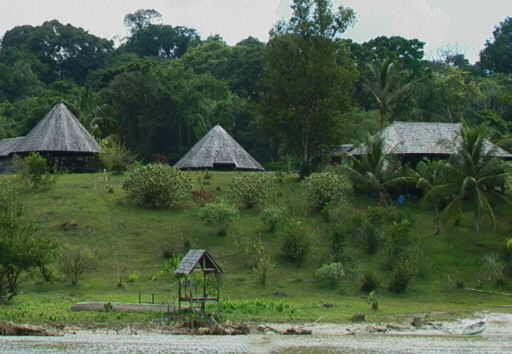
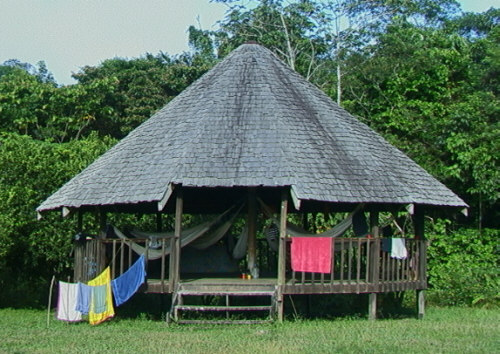
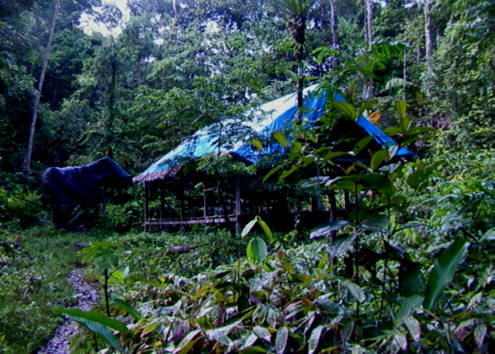
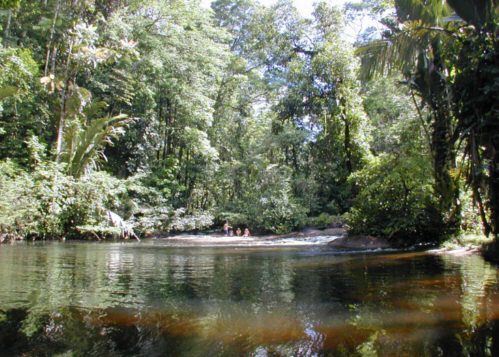
We could spot "our" camp from afar. It is situated on a small hill in a dreamlike location. Simple facilities and huts, but quite luxurious for the jungle. Showers and toilets are also available. We slept in hammocks in circular huts specially built for this purpose. These naturally have no walls, as the temperature here never drops below 25 degrees.
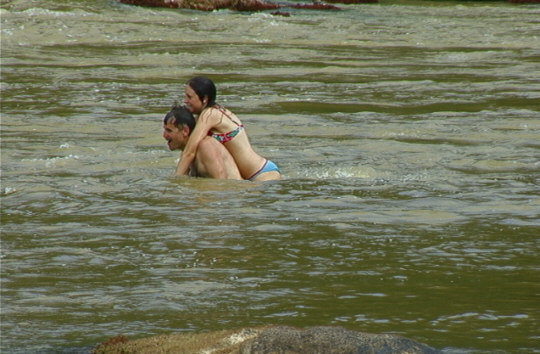
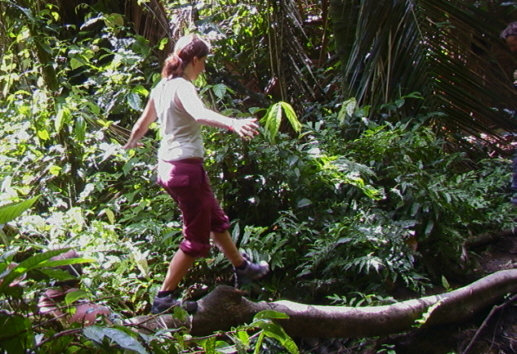
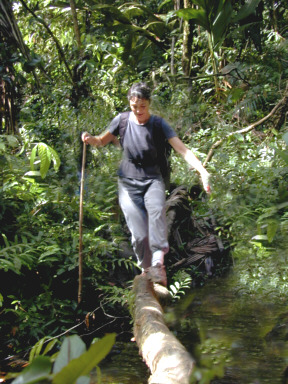
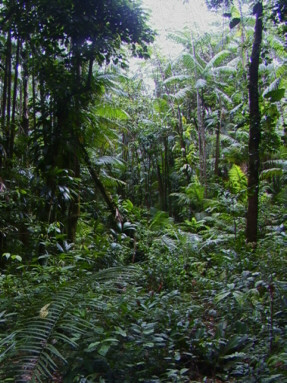
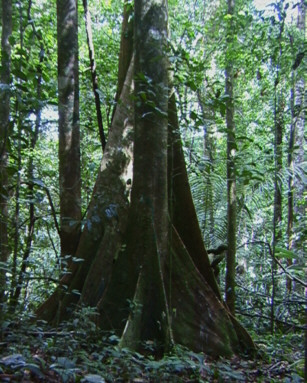
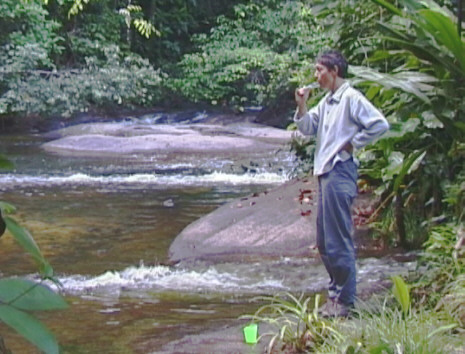
On the first day, the only items on the agenda were swimming in the river and a 2.5-hour jungle walk. During this walk, we benefited greatly from Gérard's knowledge and jungle experience. Large colorful butterflies, birds, and some smaller reptiles were unfortunately the only animals that did not hide from us. The next day, we moved our camp even deeper into the jungle. After a walk of about 3 hours, we reached the second camp, built by Gérard himself, near Saut Athenas. Just a simple hut, surrounded by dense jungle and a river with clear water. Here we could hear a wide variety of animal sounds, but unfortunately again saw no animals. The jungle is full of life, but it is not a zoo where animals are exhibited and presented to us on a silver platter. The next day, we headed back to the main camp. To our horror, we discovered that the entire water system was literally on the ground. During the previous night, a gust of wind had knocked over the water tank standing on three posts, and it now lay shattered on the earth. I really felt sorry for Gérard at that moment, because I know what tedious work awaits him now. The 3,000-liter tank will now have to be laboriously brought by pirogue, then hauled up the small hill without a road and without a tractor. Better him than me.
To top it all off, we were served a special meal: an anaconda, prepared house style. At first, I had to overcome a few qualms. You shouldn't eat that, I thought. Wild animals like that must be protected. After some hesitation, I was eventually convinced that different rules apply here in the jungle, and that such animals are indeed hunted here for personal use. Back home in Switzerland, after all, we also eat chamois and wild boar. So alright, I enjoyed the meal and simply adapted to the customs of the country.
The return trip by pirogue turned out a bit wetter. We were drenched from above rather than from below. As befits the rainforest, we were bid farewell with a proper rain shower during the ride. At these high temperatures, however, such rain is rather to be regarded as a welcome refreshment.